File Extension Best Practices: Manage, Convert & Troubleshoot

TL;DR:
- Consistent file naming conventions improve searchability, sorting, and automation across teams.
- Using lowercase and avoiding problematic characters ensures compatibility across different operating systems.
- Automating file management and enforcing standards reduces errors and saves time in the long run.
File extensions seem minor until a client can’t open your report, a script breaks because of an unexpected character in a filename, or an entire shared drive becomes a guessing game. These small suffixes control how every operating system, application, and automated workflow identifies and handles your files. Get them wrong and you lose time, credibility, and sometimes data. Get them right and your files open instantly, sort predictably, and travel across platforms without drama. This article walks through the core best practices for naming, organizing, and managing file extensions so you can prevent problems before they start and fix them fast when they do.
Table of Contents
- Establishing consistent and clear file naming conventions
- Avoid common naming pitfalls and ensure compatibility
- Lowercase vs. uppercase: case sensitivity and platform issues
- Documenting conventions and automating file management
- Our take: Why clarity beats cleverness with file extensions
- Next steps: Resources for handling file extensions
- Frequently asked questions
Key Takeaways
| Point | Details |
|---|---|
| Consistent conventions | Descriptive names with clear extensions reduce errors and speed up work. |
| Avoiding pitfalls | Skipping special characters and case confusion keeps files accessible everywhere. |
| Document for teams | Written guidelines and automation help everyone stay aligned on file extension best practices. |
| Case sensitivity matters | Linux treats extension case strictly; always use lowercase for the widest compatibility. |
Establishing consistent and clear file naming conventions
Consistency is the single most powerful thing you can do for file management. When every file follows the same naming pattern, you can search, sort, and automate with confidence. Without it, you end up with folders full of files named “final,” “final2,” and “FINAL_USE_THIS_ONE” with no dates and no context.
A strong naming convention has a few core ingredients:
- Date first, in ISO format: Use YYYYMMDD or YYYY-MM-DD so files sort chronologically by default. “20260315_report_v1.pdf” is immediately more useful than “march_report.pdf.”
- Project or department identifier: A short prefix like “MKT” or “DEV” makes cross-team searches fast.
- Version numbers: Use “v1,” “v2,” or “v01” for consistency. Avoid words like “final” or “revised” since they become meaningless quickly.
- Always preserve the extension: Never rename or strip the three-letter extension. It tells the OS and every application what the file actually is.
The Harvard Library recommends using consistent, descriptive naming including ISO dates, project names, version numbers, and always preserving the file extension. This is not just academic advice. IT teams, legal departments, and creative agencies all report fewer errors and faster retrieval when these rules are written down and followed.
“A naming convention is only as good as its adoption. If half the team follows it and half doesn’t, you still have chaos.”
Building a team reference guide does not need to be complicated. A one-page document or a shared spreadsheet with examples is enough. Pin it in your team’s chat channel or wiki. Update it when new file types get added to your workflow.
Pro Tip: Use good file extension management habits as the foundation of your reference guide. Pair it with a bookmarked file extension directory so anyone on the team can quickly look up an unfamiliar format.
Automation tools like file watchers, renaming scripts, or even simple folder rules in Windows and macOS can enforce naming conventions automatically. When a file lands in a watched folder, a script can rename it to match your convention before anyone touches it. That removes human error from the equation entirely.
Avoid common naming pitfalls and ensure compatibility
Even teams with good intentions make naming mistakes that cause real problems. The most common culprits are characters and habits that look harmless but break things in specific environments.
Here are the top mistakes to eliminate:
- Spaces in filenames: A space becomes “%20” in URLs and can break command-line scripts entirely. Use underscores or hyphens instead.
- Special characters: Characters like "~ ! @ # $ % ^ & * ; < > ? , ] { } ’ " |` are [reserved or problematic across operating systems and should never appear in a filename.
- Inconsistent capitalization: “Report.PDF” and “report.pdf” may look like the same file to you but behave differently on Linux servers.
- Vague names: “document1.docx” or “untitled.xlsx” tell you nothing. Six months later, nobody knows what they contain.
- Changing extensions manually: Renaming “image.png” to “image.jpg” does not convert the file. It just confuses every application that tries to open it.
These mistakes compound fast. A single shared drive with inconsistent naming can waste hours of productivity per week across a team. The fix is to address it before it grows.
Pro Tip: If you have a legacy folder full of poorly named files, use a bulk renaming tool like Bulk Rename Utility (Windows) or Renamer (Mac) to apply consistent conventions in minutes instead of hours. Pair this with solid file extension troubleshooting habits to catch issues early.
For ongoing prevention, set up folder rules or intake forms that require proper naming before files are saved or submitted. If your team uses a project management tool, enforce naming at upload. You can also read more about file extension changes and fixes to understand what happens when extensions get altered accidentally and how to recover.
The bottom line is simple: clean names mean fewer errors, faster searches, and smoother automation. Every minute spent fixing a naming convention upfront saves ten minutes of troubleshooting later.
Lowercase vs. uppercase: case sensitivity and platform issues
Case sensitivity is one of the most overlooked sources of file compatibility problems, especially for teams that work across multiple operating systems. The core issue is that different platforms handle case very differently.
| Operating system | Case-sensitive filenames? | Best practice |
|---|---|---|
| Linux | Yes | Always use lowercase |
| Windows | No | Lowercase recommended |
| macOS | No (by default) | Lowercase recommended |
| Web servers (Linux-based) | Yes | Lowercase required |
This matters most when files move between systems. A file named “Report.PDF” works fine on Windows but may fail to load on a Linux web server if the link references “report.pdf.” That mismatch causes broken links, missing assets, and failed scripts.

The safest rule is to default to lowercase for all filenames and extensions. It works everywhere. There is no scenario where lowercase causes a compatibility problem that uppercase would solve.
The Google Developer Style Guide recommends using lowercase filenames with hyphens and referring to file types by name rather than extension alone. So instead of saying “.png file,” say “PNG file.” This practice makes documentation clearer and less dependent on extension formatting.
“Lowercase is the universal language of filenames. It travels across every platform without friction.”
A few more case-related best practices:
- Never mix cases within the same project folder.
- Avoid camelCase in filenames (“ProjectReport.docx”) since it creates inconsistency.
- Use hyphens or underscores, not capital letters, to separate words.
For a deeper look at how platform differences affect your files, the guide on file format differences covers the technical side clearly. You can also explore file type differences to understand how format and extension interact across platforms.
Documenting conventions and automating file management
Knowing best practices is one thing. Making them stick across a team of ten, fifty, or five hundred people is another challenge entirely. Documentation and automation are the two tools that bridge that gap.
Here is a simple process for creating a team file extension guide:
- List all file types your team uses regularly. Include documents, images, videos, data exports, and any proprietary formats.
- Define the naming pattern for each type. Be specific. “YYYYMMDD_projectcode_description_v#.ext” is better than “use dates and versions.”
- Add examples for every rule. Examples eliminate ambiguity faster than any written explanation.
- Store the guide somewhere everyone can find it. A shared drive, wiki, or team handbook all work.
- Review it quarterly. File types and workflows change. Your guide should keep up.
Once the guide exists, automation makes it scale. Here is a quick comparison of manual versus automated enforcement:
| Approach | Effort | Consistency | Best for |
|---|---|---|---|
| Manual naming | High | Low | Small teams, simple workflows |
| Folder rules and scripts | Medium | High | Mid-size teams, shared drives |
| Automated intake systems | Low | Very high | Large teams, high file volume |
Pro Tip: A simple Python or PowerShell script can scan a folder, check every filename against your convention, and flag or rename non-compliant files automatically. You do not need to be a developer to use these. Many are available as free templates online.
Automation also protects you from the most common human error: forgetting. When a script handles renaming, the convention applies every time without relying on anyone to remember the rules. For teams managing large shared drives, this is not optional. It is essential. Learning to identify file extensions correctly is also a key part of building any reliable automation, since scripts need to recognize formats accurately to rename or sort them properly.
The Harvard Library’s best practice guidance reinforces this: document conventions explicitly, use ISO dates, and enforce standards with tools or automation. That combination is what separates teams that manage files well from those that spend Friday afternoons hunting for the right version of a document.
Our take: Why clarity beats cleverness with file extensions
After working through thousands of file management scenarios, one pattern stands out clearly. The teams and individuals who handle file extensions best are not the most technically sophisticated. They are the most consistent.
We have seen projects derailed by creative naming schemes that made perfect sense to the person who invented them and zero sense to anyone else. A folder full of files named by internal codenames, abbreviated in ways only one person understood, caused a three-day delay when that person left the company. That is a real cost.
Clarity scales. A boring, predictable naming convention works for a team of two and still works when the team grows to two hundred. It survives staff turnover, platform migrations, and software upgrades. Clever naming does not.
The tools and platforms being built today, from cloud storage to AI-powered search, reward consistency. They index, sort, and retrieve files based on structured metadata and predictable patterns. The lessons from format clarity apply directly here. Simple, standardized extensions and names are the foundation everything else builds on. Boring is good. Boring works.
Next steps: Resources for handling file extensions
You now have a solid framework for managing file extensions across naming, compatibility, documentation, and automation. But questions will keep coming up, especially when you encounter an unfamiliar format or a file that simply will not open.
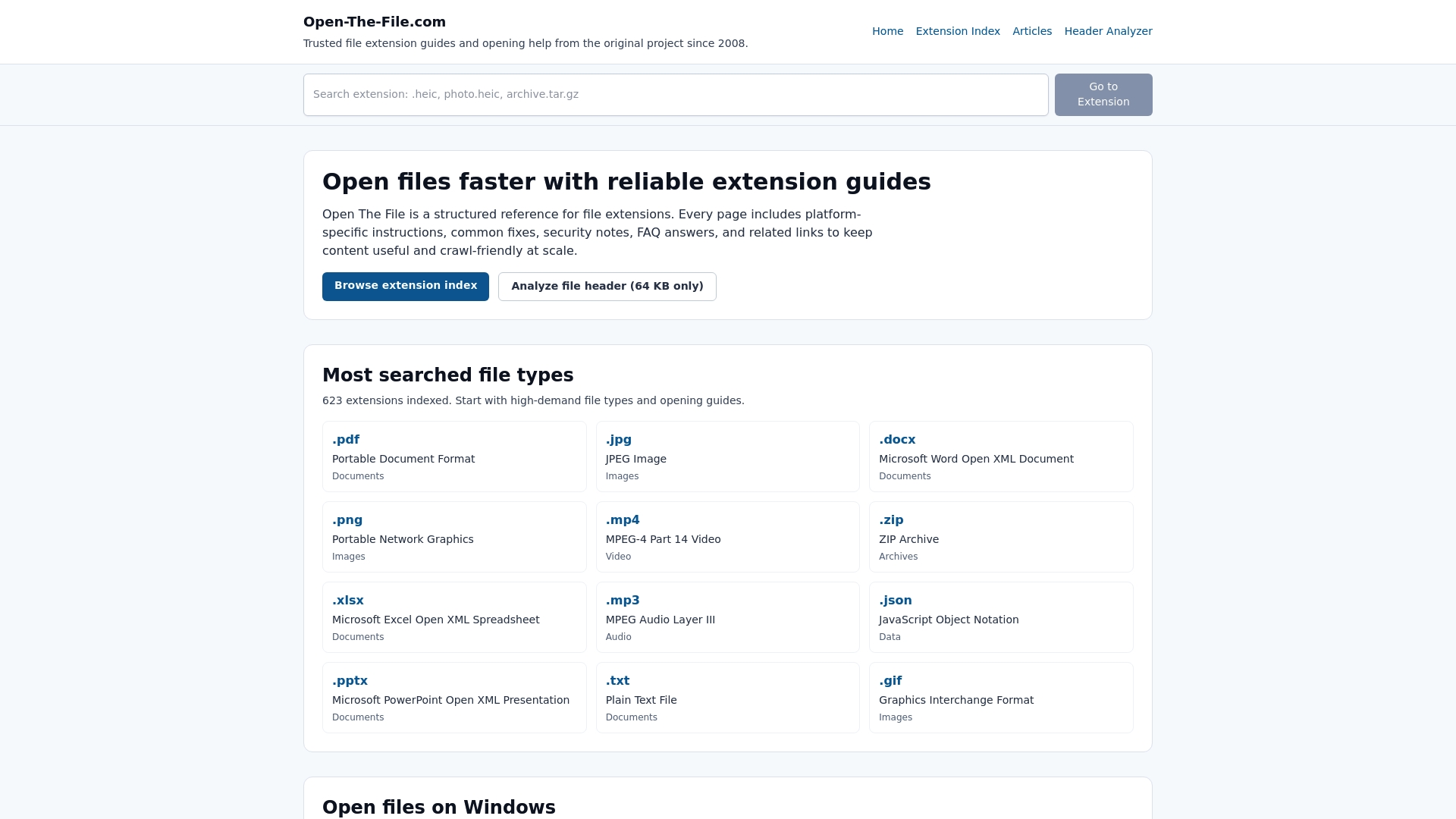
Open-The-File.com exists exactly for those moments. The file extension index covers over 750 file formats with clear guidance on what each extension means, which applications open it, and how to handle it on both Windows and Mac. Whether you need to troubleshoot a file that won’t open or find a safe conversion path, the extension guides walk you through it step by step without the jargon. Bookmark it as your go-to reference for any file extension challenge.
Frequently asked questions
Why are file extensions important for compatibility?
File extensions tell the operating system and applications what format a file uses and how to open it. Missing or mismatched extensions cause errors, broken workflows, and files that simply will not open.
How can I bulk-rename files with poor extensions or names?
Bulk renaming tools like Bulk Rename Utility or Renamer let you apply consistent naming conventions to hundreds of files at once. Automation tools and scripts take this further by enforcing conventions automatically as new files arrive.
Are file extension naming rules the same on Mac, Windows, and Linux?
Core principles apply across all platforms, but Linux is case-sensitive for filenames while Windows and macOS are not. Using lowercase everywhere gives you maximum compatibility across all three systems.
What’s the quickest way to tell what type of file someone sent me?
Check the file extension and look it up in a reliable file extension directory to find out what format it is, which programs open it, and whether you need to convert it before use.