Types of file extensions: troubleshooting guide 2026

Every day, you interact with dozens of file extensions, yet many remain mysterious when they fail to open or behave unexpectedly. Understanding the different types of file extensions and how Windows and macOS identify them transforms frustrating troubleshooting sessions into quick fixes. This guide reveals how operating systems recognize file types, categorizes major extension families, and equips you with practical troubleshooting strategies to resolve common extension issues efficiently across both platforms.
Table of Contents
- Key takeaways
- How to categorize and understand file extension types
- How Windows recognizes and manages file extensions
- How macOS identifies file types beyond extensions
- Edge cases and security risks of relying on file extensions
- Explore comprehensive file extension resources
- FAQ
Key Takeaways
| Point | Details |
|---|---|
| Windows extension reliance | Windows uses the file extension stored in the registry to determine default programs and how files are opened. |
| Show extensions in Explorer | Enable file name extensions in File Explorer to reveal hidden extensions that can mislead you about a file type. |
| Reset file associations | If a file opens with the wrong program, reset the default associations in Settings to reassign the correct program. |
| macOS UTIs approach | macOS relies on Uniform Type Identifiers in addition to extensions to identify and classify files more accurately. |
How to categorize and understand file extension types
File extensions are categorized into documents, images, audio, video, archives, executables, scripts, spreadsheets, and system files. Recognizing these categories helps you quickly identify which software opens specific files and diagnose problems when associations break. Documents like .docx and .pdf store formatted text, while images such as .jpg and .png contain visual data. Audio files including .mp3 and .wav hold sound recordings, and video formats like .mp4 and .avi combine audio with moving images.
Archives such as .zip and .rar compress multiple files for storage or transfer. Executables like .exe files and macOS .app bundles launch programs, while scripts including .py and .js contain code instructions. Spreadsheets such as .xlsx organize data in rows and columns, and system files like .dll and .sys support operating system functions. Understanding these file extension categories creates a mental framework for troubleshooting unknown files.
Common confusions arise when extensions overlap in usage or appear ambiguous. The .dat extension could represent game data, email attachments, or video content depending on the creating application. Similarly, .tmp files might be temporary documents, browser cache, or installation remnants. System context matters significantly because Windows prioritizes extension-based recognition while macOS considers additional metadata.
Pro Tip: When encountering an unknown file, identify its category first by researching the extension online, then verify the content matches expectations before opening it with unfamiliar software.
How Windows recognizes and manages file extensions
Windows relies primarily on file extensions via registry associations to determine file handling and default applications. The registry stores these mappings in HKEY_CLASSES_ROOT, linking each extension to specific programs and defining how the system displays and launches files. When you double-click a .docx file, Windows queries the registry to find Microsoft Word or an alternative word processor.

To troubleshoot on Windows, show extensions in File Explorer first. Open File Explorer, click the View tab, select Show, then check File name extensions. This reveals hidden extensions that might explain why files won’t open correctly. Reset associations via Settings by navigating to Apps, then Default apps, and selecting the file type or extension you want to reconfigure.
Common issues include incorrect default applications opening files or hidden extensions causing confusion about file types. A file appearing as “document” might actually be “document.exe” with the extension hidden, posing security risks. Registry editing offers advanced troubleshooting but requires caution. Back up registry keys before making changes, and only edit when simpler methods fail.
Pro Tip: Attackers exploit double extensions like “invoice.pdf.exe” where Windows hides the dangerous .exe part, displaying only “invoice.pdf” to unsuspecting users.
Edge cases complicate Windows file handling. Some malware uses trailing spaces in filenames to disguise executables as documents. Others employ right-to-left override characters that reverse displayed text, making “fdp.exe” appear as “exe.pdf” in Explorer. Always verify file properties and scan suspicious files with security software before opening file extensions on Windows.
How macOS identifies file types beyond extensions
macOS uses Uniform Type Identifiers like public.jpeg, determined by extensions, MIME types, or content signatures. This multi-layered approach improves accuracy beyond just checking file suffixes. When you open a file, macOS examines the extension first, then verifies against internal signatures and metadata to ensure the file matches its claimed type.
The ‘file’ command in Terminal reveals true file types regardless of extensions. Open Terminal and type ‘file /path/to/yourfile’ to see detailed type information. The ‘mdls’ command displays extended attributes including UTI data, helping identify files with misleading or missing extensions. These tools prove invaluable when troubleshooting files that won’t open or behave unexpectedly.
To troubleshoot on macOS, show extensions in Finder by opening Finder Settings, clicking Advanced, then checking Show all filename extensions. Change default app associations by right-clicking a file, selecting Get Info, choosing an application under Open with, then clicking Change All to apply the association system-wide for that file type.
macOS’s robustness reduces but doesn’t eliminate extension spoofing risks. Malicious files can still disguise themselves, particularly when users disable Gatekeeper protections or install software from unverified sources. The system warns about unrecognized developers and unsigned applications, but determined attackers craft convincing social engineering scenarios to bypass these safeguards.
Handling files with misleading or missing extensions requires verification beyond visual inspection. Use the file extension identification guide to cross-reference suspected file types with their actual content signatures. macOS’s Quick Look feature (spacebar preview) often reveals file contents without fully opening them, providing a safer inspection method.
Edge cases and security risks of relying on file extensions
Files without extensions can be identified by magic bytes at the beginning of file content. These signature bytes uniquely identify file formats regardless of naming. JPEG files start with FF D8 FF, PNG files begin with 89 50 4E 47, and PDF documents open with 25 50 44 46. The ‘file’ command on macOS and Linux reads these signatures automatically, while Windows users need third-party tools or hex editors.
Common spoofing risks include double extensions where “report.pdf.exe” displays as “report.pdf” with hidden extensions enabled in default Windows settings. Trailing spaces create "invoice.exe " appearing as “invoice.exe” in some views but behaving differently when executed. Right-to-left override characters reverse displayed text, transforming “fdp.exe” into what looks like “exe.pdf” to casual observers.
| Spoofing Tactic | Visual Appearance | Actual File Type | Identification Strategy |
|---|---|---|---|
| Double extension | document.pdf | document.pdf.exe | Show all extensions, check properties |
| Trailing spaces | invoice.exe | invoice.exe | Use command line tools, inspect hex |
| RTL override | exe.pdf | fdp.exe | Copy filename to text editor, check encoding |
| Icon masquerading | Word document icon | malware.exe | Verify file signatures, scan with antivirus |
| MIME mismatch | image.jpg | script.js | Open in hex editor, check magic bytes |
Security risks exist because extensions can be spoofed easily. Never trust extension alone for validation; always check content through multiple verification methods. Best practices for verifying files safely include:
- Scan all downloaded files with updated antivirus software before opening
- Use command line tools to reveal true file types beyond visual inspection
- Enable full extension display on both Windows and macOS permanently
- Verify file sources and sender authenticity before trusting attachments
- Inspect file properties and metadata for inconsistencies or suspicious details
- Open questionable files in sandboxed environments or virtual machines first
Understanding file format security risks requires recognizing that filename components serve as user interface elements, not security boundaries. Sophisticated attacks exploit how operating systems display filenames versus how they execute files. File signature identification through hex analysis provides definitive answers when visual inspection fails.
MIME type mismatches occur when web servers send incorrect content type headers, causing browsers to mishandle downloads. A JavaScript file served with image/jpeg MIME type might bypass browser security checks designed to warn about executable content. Always verify downloaded file content matches expected type before executing or opening with applications that support scripting or macros.
Explore comprehensive file extension resources
Navigating 750+ file types becomes manageable with the right resources at your fingertips. Open-The-File.com maintains an extensive file extension index directory organized by category, providing instant access to detailed guides for both common and obscure extensions. Whether you’re troubleshooting a mysterious .dmp file or need quick instructions for opening .pages documents on Windows, the indexed directory delivers step-by-step solutions.
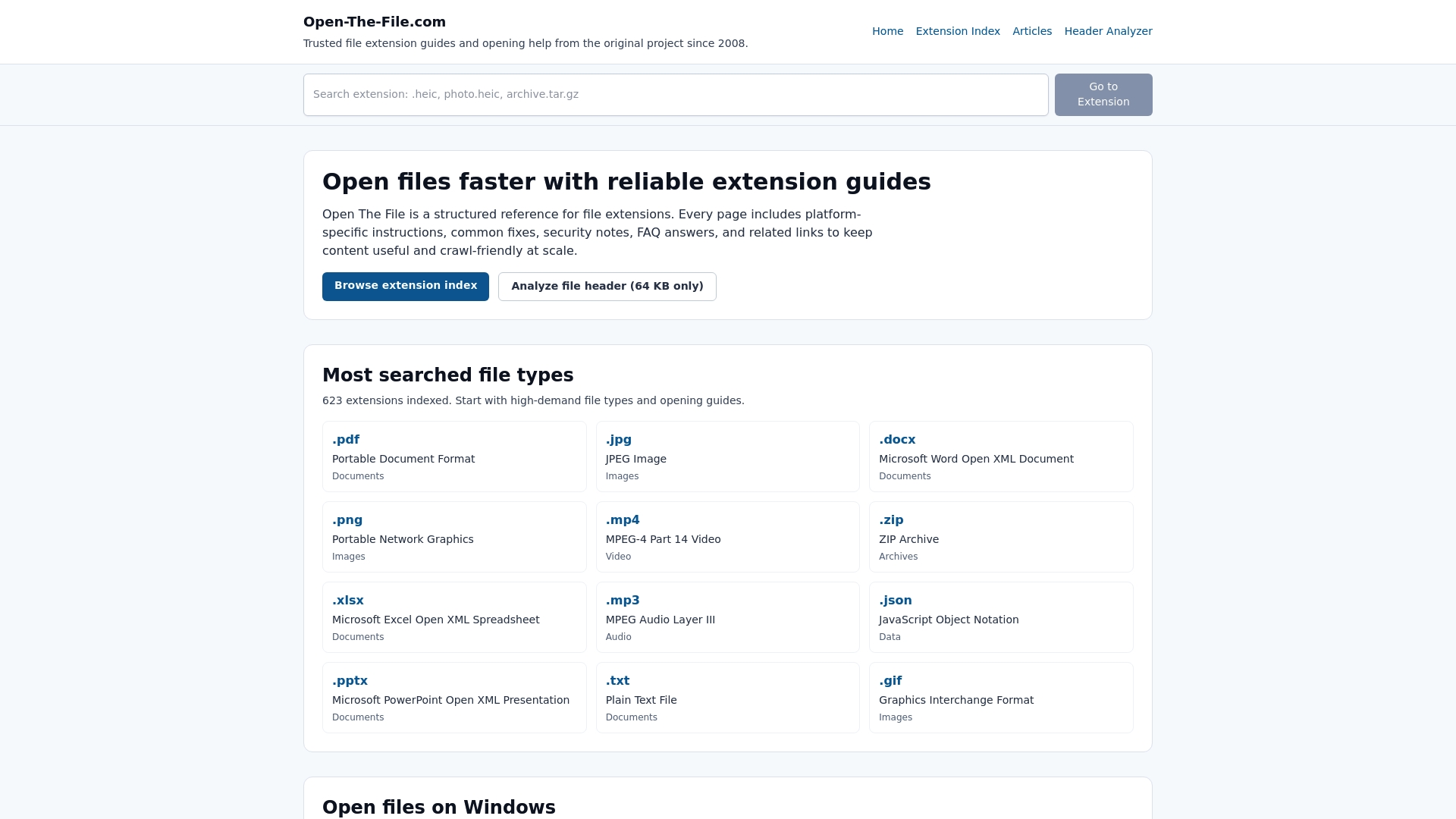
The platform offers extension guides for 750+ file types with platform-specific instructions for Windows and macOS users. Each guide includes security considerations, common issues, and recommended software options. When extension visibility problems or broken file associations disrupt your workflow, these comprehensive resources provide tested troubleshooting procedures that resolve issues quickly without requiring deep technical knowledge.
FAQ
What are the most common file extension categories and their typical uses?
Documents like .docx and .pdf store text and formatted content for word processing and universal viewing. Images including .jpg and .png contain graphical data optimized for photographs or transparent graphics. Audio files such as .mp3 and .wav hold sound recordings in compressed or lossless formats. Video formats like .mp4 combine audio with moving images for multimedia playback.
How can I display file extensions on Windows and macOS?
On Windows, open File Explorer, click the View tab, select Show, then check File name extensions to reveal all suffixes. For macOS, open Finder, navigate to Settings, click Advanced, then check Show all filename extensions to display them system-wide. Both settings persist across sessions and apply to all folders. Enabling extension visibility is the essential first step when troubleshooting file type issues.
Are file extensions reliable indicators of file content and safety?
Extensions provide initial clues but can be spoofed by attackers to hide true file types. Malicious actors use double extensions, trailing spaces, and Unicode tricks to disguise executables as harmless documents. Use file signature identification tools and system commands to verify content matches the extension. Never trust filename alone for security decisions, especially with email attachments or downloads from unfamiliar sources.
What tools help identify files without extensions or with misleading names?
The ‘file’ command on macOS and Linux analyzes magic bytes to determine true file types regardless of extensions or filenames. Windows users can employ hex editors to inspect file signatures manually or use third-party identification utilities. The ‘mdls’ command on macOS reveals Uniform Type Identifiers and extended metadata. These tools prove essential when troubleshooting corrupted downloads, renamed files, or suspected malware disguised with deceptive extensions.
How do I fix broken file associations that open files with wrong applications?
Windows users should navigate to Settings, then Apps, then Default apps to reassign file types to correct programs. Right-click a file, select Open with, choose the desired application, then check Always use this app. macOS users right-click files, select Get Info, choose an application under Open with, then click Change All to apply system-wide. Registry editing on Windows or resetting Launch Services on macOS provides advanced solutions when standard methods fail.
Recommended
- File extension identification: steps for Windows & macOS | Open-The-File.com
- How to open file extensions on Windows and macOS in 2026 | Open-The-File.com
- File format differences explained: IT pros guide 2026 | Open-The-File.com
- Articles - File Tips & Guides | Open-The-File.com
- Files for your 3D printer – CacheWerk