Essential types of document formats and how to use them

TL;DR:
- Compatibility and conversion are key to avoiding document opening issues.
- PDF is the most universal format for sharing and archiving, while DOCX and ODT are best for editing.
- Using batch tools like LibreOffice CLI ensures fast, reliable document conversions on Windows and Mac.
You click a file and nothing happens. Or worse, it opens in the wrong program and looks completely broken. This happens to nearly every computer user at some point, and the root cause is almost always a mismatch between the document format and the software trying to read it. Understanding the main types of document formats, what makes each one unique, and when to convert between them is the fastest way to stop losing time to compatibility problems. This guide walks you through everything you need to know, whether you’re working on Windows, Mac, or both.
Table of Contents
- How to evaluate document formats: Key criteria
- The main types of document formats explained
- Side-by-side comparison: Which document format fits your needs?
- How to convert and open document formats on Windows and Mac
- Why format headaches persist and how to future-proof your files
- Find the right document solution fast
- Frequently asked questions
Key Takeaways
| Point | Details |
|---|---|
| Choose the right format | Selecting the correct document format prevents compatibility headaches and data loss. |
| Know your conversion tools | With the right software or built-in apps, you can easily convert between formats on any platform. |
| Future-proof with standard formats | Saving important files in widely supported formats like PDF or ODT ensures long-term accessibility. |
| Batch converting saves time | Efficient tools like LibreOffice CLI can convert many files at once with minimal effort. |
How to evaluate document formats: Key criteria
Not all document formats are created equal, and the right choice depends entirely on what you’re trying to do. Before picking a format or deciding to convert, it helps to think through a few key factors.
The most common scenarios where format choice matters include sharing files with clients or colleagues, editing documents collaboratively, archiving records for long-term storage, and meeting compliance requirements in regulated industries. Each scenario pulls in a different direction.
Here are the main criteria to weigh when evaluating a format:
- Compatibility: Will the recipient’s software open it without errors?
- Editability: Can the content be changed, or is it locked?
- File size: Does the format compress well, or will it clog inboxes?
- Security: Does it support password protection or digital signatures?
- Longevity: Will the format still be readable in 10 or 20 years?
The file format differences between common types are more significant than most users realize. For example, main document formats include PDF (fixed-layout, universal), DOCX (editable Microsoft standard using ZIP XML), DOC (legacy binary), ODT (open ISO standard), RTF (interchange), TXT (plain text), and office variants like XLSX and PPTX. Each was built for a specific purpose, and using the wrong one creates friction.
Sometimes you need to convert even if your app can technically view a file. Viewing and editing are different things. A PDF might display perfectly in Preview on Mac, but if you need to change a sentence, you’ll need to convert it first. Understanding why convert file formats before you start a project saves a lot of backtracking.
Pro Tip: Before sending any document, check what software the recipient uses. A beautifully formatted DOCX file can look like a jumbled mess when opened in an older version of Word or a non-Microsoft app.
The main types of document formats explained
With your evaluation criteria in mind, let’s detail the key document formats you’ll encounter on a daily basis.
According to the document format standard, the most widely used formats span fixed-layout, editable, open-standard, and plain-text categories. Here’s a breakdown of each:
| Format | Type | Best for | Editable? |
|---|---|---|---|
| Fixed layout | Sharing, printing, archiving | Limited | |
| DOCX | XML-based | Word processing, editing | Yes |
| DOC | Legacy binary | Older Word files | Yes (with caveats) |
| ODT | Open ISO standard | Free office suites | Yes |
| RTF | Interchange | Cross-app text sharing | Yes |
| TXT | Plain text | Simple notes, code | Yes |
| XLSX | Spreadsheet XML | Data and calculations | Yes |
| PPTX | Presentation XML | Slides and visuals | Yes |
PDF is the go-to for anything you want to look the same on every screen. It locks the layout, embeds fonts, and opens on virtually any device. The tradeoff is that editing requires specialized software.

DOCX is the modern Microsoft Word format. It’s built on open XML standards, meaning it’s more stable and widely supported than its predecessor. Most word processors handle it well.
DOC is the older binary format from Word 97 to 2003. It still works, but you may run into rendering issues on newer systems. It’s worth converting old DOC files to DOCX for future safety.
ODT is the open-source world’s answer to DOCX. It’s the default format for LibreOffice and similar suites. It follows an ISO standard, which makes it a strong archiving choice.
RTF was designed to move formatted text between different applications without losing basic structure. It’s older but surprisingly reliable for simple documents.
TXT strips everything down to raw text. No fonts, no tables, no images. That simplicity makes it universally readable, which is why developers and system admins love it.
For a broader look at how these fit into the larger picture, our file types guide covers the full spectrum beyond just documents.
Pro Tip: If you’re building a document archive, save important files in both ODT and PDF. ODT keeps content editable, while PDF preserves the visual snapshot.
Side-by-side comparison: Which document format fits your needs?
After understanding each format’s strengths, here’s how they compare side-by-side for common uses.
| Format | Windows | Mac | Mobile | Editable | Secure | Best use case |
|---|---|---|---|---|---|---|
| Yes | Yes | Yes | Limited | Yes | Sharing, archiving | |
| DOCX | Yes | Yes | Yes | Yes | Partial | Editing, collaboration |
| DOC | Yes | Partial | Limited | Yes | No | Legacy files |
| ODT | Yes | Yes | Limited | Yes | No | Open-source workflows |
| RTF | Yes | Yes | Limited | Yes | No | Simple cross-app sharing |
| TXT | Yes | Yes | Yes | Yes | No | Plain notes, scripts |
| XLSX | Yes | Yes | Yes | Yes | Partial | Spreadsheets, data |
| PPTX | Yes | Yes | Yes | Yes | Partial | Presentations |
PDF stands out as nearly universal, but it’s a poor choice when the recipient needs to edit content. A better workflow for opening docs often involves sending a DOCX for review and a PDF for final delivery.
A few patterns worth noting:
- DOC files can cause unexpected formatting shifts on Mac, especially in Pages
- ODT files open in Word 2013 and later, but complex formatting sometimes shifts
- TXT files are the only format guaranteed to open correctly on every platform without any software beyond a basic text editor
“PDF conversion preserves layout best for sharing, and LibreOffice CLI benchmarks show it converts 12 DOC files to PDF/A in just 8.3 seconds, making it the fastest option for batch work.”
That speed advantage matters when you’re dealing with dozens or hundreds of files at once. Choosing the right tool for the job is just as important as choosing the right format.
How to convert and open document formats on Windows and Mac
Understanding formats is only useful if you can actually open or convert your files. Here’s how to do it.
Native tools available on each platform:
- Windows: Microsoft Word, WordPad (RTF and TXT), Notepad (TXT)
- Mac: Pages, TextEdit (handles RTF and TXT), Preview (PDF)
- Cross-platform free option: LibreOffice (handles almost every format listed above)
Step-by-step: Converting a DOC or DOCX to PDF
- Open the file in Microsoft Word or LibreOffice
- Click File, then Save As (Word) or Export As (Pages)
- Select PDF from the format dropdown
- Choose your quality settings (standard for sharing, high for printing)
- Click Save or Export
Step-by-step: Batch converting with LibreOffice CLI on Windows or Mac
- Install LibreOffice from the official site
- Open Terminal (Mac) or Command Prompt (Windows)
- Run: "soffice --headless --convert-to pdf *.doc`
- All DOC files in the folder convert to PDF automatically
Benchmark data confirms LibreOffice CLI is the fastest batch conversion tool available, completing 12 DOC to PDF/A conversions in 8.3 seconds. No GUI tool comes close for volume work.
For online converters, they work well for one-off tasks but carry privacy risks. Never upload sensitive contracts, medical records, or financial documents to a web-based converter.
Our file tips and guides cover specific conversion paths for dozens of formats if you need more detail beyond documents.
Pro Tip: Always back up your original files before running a batch conversion. Conversion is rarely destructive, but edge cases exist, and losing an original is never worth the risk.
Why format headaches persist and how to future-proof your files
Here’s a hard-won lesson we’ve learned from years of helping users troubleshoot file problems: the format issue never fully goes away, and that’s not an accident.
Software companies have a financial incentive to keep their formats slightly incompatible with competitors. Microsoft, Apple, and Google all have default formats that work best inside their own ecosystems. This fragmentation is deliberate, not a technical limitation.
The practical result is that even in 2026, a file created in one app can look wrong in another. The fix most people miss is simple: save important documents in two formats. Keep the editable version in DOCX or ODT for future changes, and export a PDF for anything you send out or archive. This two-format habit takes seconds and prevents almost every compatibility problem.
For anyone managing files professionally, reading IT pro format advice on long-term format strategy is worth the time. The goal is not to find the perfect format. It’s to stop being surprised when a file doesn’t open the way you expected.
Find the right document solution fast
Dealing with a file that won’t open is frustrating, but it’s almost always solvable once you know where to look. Open-The-File.com exists to make that process faster and less stressful.
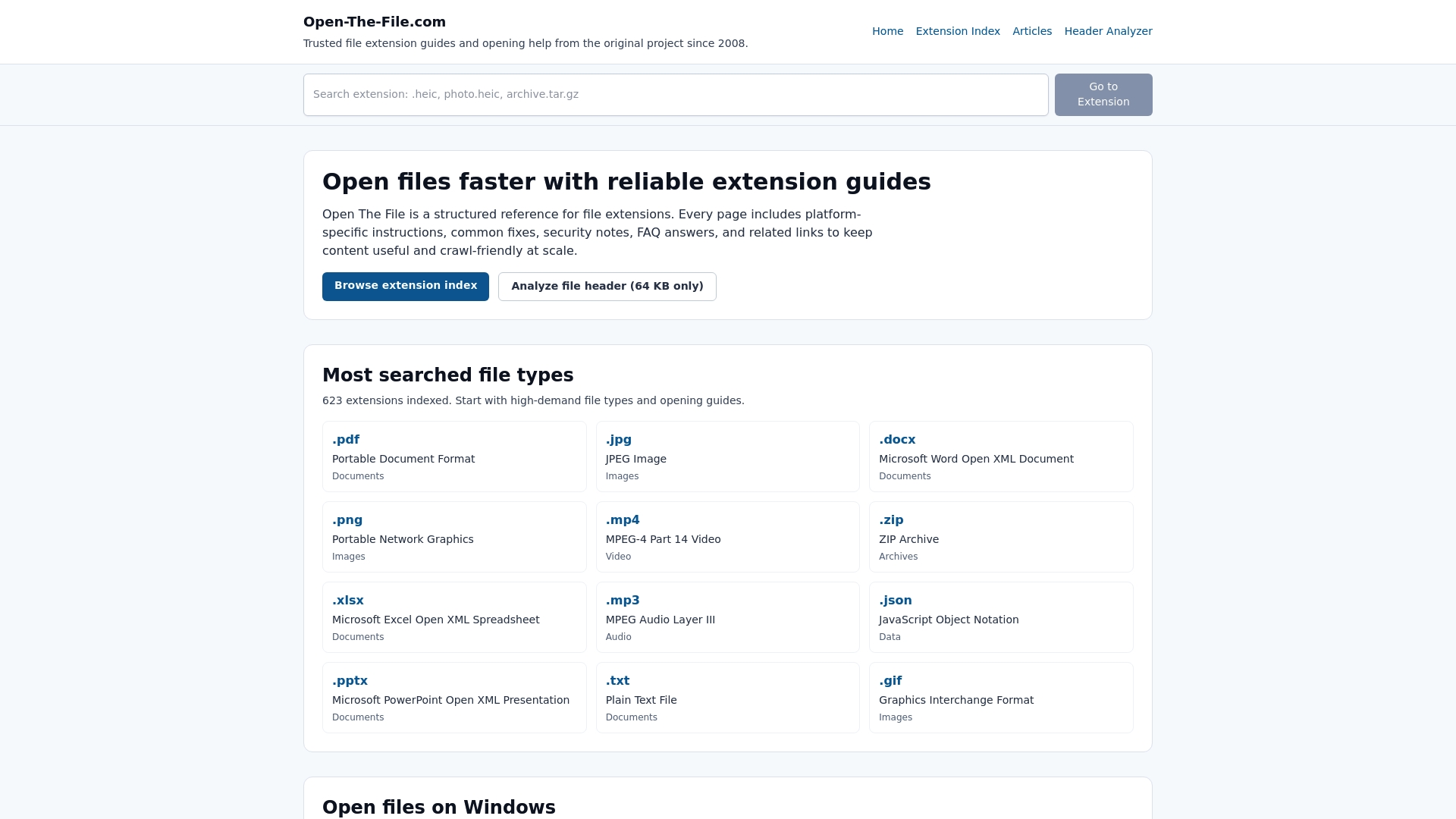
Whether you need to identify an unfamiliar extension, find the right software to open a specific format, or follow a step-by-step conversion guide, the file extension directory covers over 750 formats with clear, jargon-free instructions for both Windows and Mac. Open The File is built for exactly the situation you’re in right now. No technical background required, just fast, reliable answers when a file refuses to cooperate.
Frequently asked questions
What is the most universal document format?
PDF is the most universal document format because it preserves appearance universally and opens correctly on almost any device or operating system without requiring specific software.
How can I open an ODT file on Windows?
You can open ODT files on Windows using LibreOffice, Microsoft Word 2013 or later, or a free online viewer. The ODT open ISO standard ensures broad software support.
What’s the fastest way to batch convert DOC files to PDF?
LibreOffice CLI benchmarks show it converts 12 DOC files to PDF/A in 8.3 seconds, making it the fastest available tool for batch conversion tasks.
Is it safe to use online file converters?
Online converters are convenient for non-sensitive files, but you should avoid uploading private or confidential documents. Always back up originals before converting through any third-party service.
What’s the difference between DOC and DOCX?
DOC is legacy binary format from older Word versions, while DOCX uses open XML standards and is more stable, smaller in file size, and better supported by modern software across all platforms.
Recommended
- Differences in file types: a clear guide for all users | Open The File
- Articles - File Tips & Guides | Open The File
- Common image file types: how to choose and troubleshoot | Open The File
- File format differences explained: IT pros guide 2026 | Open The File
- Types of legal documents: your 2026 guide