Common image file types: how to choose and troubleshoot

Choosing the right image file type can feel overwhelming when you’re faced with dozens of options, each with different strengths and compatibility quirks. Whether you’re a content creator optimizing web graphics, a casual user sharing photos, or an IT professional troubleshooting file access issues, understanding the core differences between formats saves time and frustration. This guide breaks down the most common image file types, explains what makes each one unique, and provides practical troubleshooting tips to help you make confident decisions in 2026.
Table of Contents
- How To Evaluate And Choose Image File Types
- Common Image File Types Explained: Formats And Features
- Comparing Image File Types: A Side-By-Side Analysis
- Recommended Use Cases And Troubleshooting Tips For Image File Types
- Explore File Extension Guides And Tools At Open-The-File.com
- Frequently Asked Questions
Key takeaways
| Point | Details |
|---|---|
| Compression method matters | Lossy formats like JPEG reduce file size but sacrifice quality, while lossless formats like PNG preserve every detail. |
| Transparency support varies | PNG and GIF support transparent backgrounds, making them ideal for logos and overlays, whereas JPEG does not. |
| Compatibility affects workflow | HEIC offers superior compression but requires conversion for non-Apple devices, while JPEG works universally. |
| Use case guides selection | Photos benefit from JPEG’s small size, graphics need PNG’s sharpness, and animations require GIF’s frame support. |
| Format knowledge speeds fixes | Understanding file type limitations helps you quickly resolve unsupported format errors and quality degradation issues. |
How to evaluate and choose image file types
Selecting the right image format starts with understanding five core criteria: compression method, quality preservation, transparency support, file size, and compatibility. Image format choice depends on compression type, quality needs, transparency, compatibility, and use case, so evaluating these factors upfront prevents headaches later.
Compression divides into two camps. Lossy compression, used by JPEG, discards some image data to shrink files dramatically, making it perfect for web photos where slight quality loss goes unnoticed. Lossless compression, found in PNG and BMP, preserves every pixel exactly as captured, ensuring crisp text and graphics but resulting in larger files. Your choice hinges on whether you prioritize storage efficiency or pixel-perfect accuracy.
Transparency support becomes critical when you need images to blend seamlessly with varied backgrounds. PNG handles transparency beautifully, letting you create logos and icons that float cleanly over any color or pattern. GIF also supports transparency but with limited color depth. JPEG lacks transparency entirely, filling any would-be transparent areas with solid color, which limits its use for layered designs.
File size directly impacts loading speed and storage costs. A 5MB BMP file might be fine for archival purposes but will frustrate website visitors on slower connections. JPEG and HEIC excel at keeping sizes manageable without destroying visual appeal. Consider your delivery method: web images demand smaller files, while print projects tolerate larger sizes for maximum detail.
Compatibility varies wildly across devices and software. JPEG enjoys near-universal support, opening effortlessly on smartphones, tablets, and desktop systems. HEIC, despite its efficiency, requires conversion for Windows users or older Android devices. Always match your format to your audience’s likely tech ecosystem.
Pro Tip: When archiving important photos, keep the original camera files (RAW when available) or export archival copies as TIFF, then create JPEG copies for everyday sharing. This preserves maximum quality while maintaining practical file sizes for distribution.
Common image file types explained: formats and features
Five formats dominate the image file landscape, each engineered for specific scenarios. Understanding their DNA helps you pick the right tool every time.
JPEG is widely used for photos balancing file size and quality. This lossy format compresses images by removing imperceptible details, achieving dramatic size reductions while maintaining visual appeal. JPEG handles millions of colors beautifully, making it the default choice for digital photography, social media uploads, and web content. However, repeated editing and saving degrades quality progressively, so preserve your originals separately.

PNG supports transparency and lossless compression, making it indispensable for graphics requiring crisp edges and see-through backgrounds. Web designers favor PNG for logos, icons, and interface elements where sharpness matters more than file size. PNG comes in two varieties: PNG-8 supports 256 colors with smaller files, while PNG-24 handles millions of colors with larger sizes. The tradeoff is straightforward: PNG files occupy more storage than equivalent JPEGs but deliver superior quality.
GIF supports animation with limited colors, restricting its palette to 256 hues maximum. This constraint makes GIF unsuitable for photographs but perfect for simple animations, small banners, and graphics with flat color areas. GIF’s animation capability, combined with tiny file sizes, explains its enduring popularity for memes and short looping clips. Transparency support exists but with hard edges rather than PNG’s smooth gradients.
HEIC offers higher compression efficiency on modern Apple devices, delivering JPEG-quality images at roughly half the file size. Introduced with iOS 11, HEIC uses advanced compression algorithms to preserve detail while minimizing storage consumption. The catch: compatibility remains limited outside Apple’s ecosystem, requiring conversion to JPEG image files or PNG image files for sharing with Windows or Android users.
BMP is usually uncompressed and often large in legacy contexts. Most BMP files store pixels with little or no compression, though the format also supports limited RLE compression in some variants. BMP survives primarily in older Windows applications and specialized technical contexts. Unless you’re maintaining legacy systems, avoid BMP entirely.
Pro Tip: When choosing between GIF file format and PNG for static graphics, pick PNG. Modern browsers handle PNG transparency better, and the quality difference is noticeable even with simple designs.
| Format | Compression | Colors | Transparency | Animation | Typical Size |
|---|---|---|---|---|---|
| JPEG | Lossy | Millions | No | No | Small |
| PNG | Lossless | Millions | Yes | No | Medium-Large |
| GIF | Lossless | 256 max | Yes | Yes | Small |
| HEIC | Usually lossy; lossless is possible | Millions | Yes | Image sequences in some uses | Very Small |
| BMP | None | Millions | No | No | Very Large |
Comparing image file types: a side-by-side analysis
Comparing formats helps choose the right file type for each use case, so let’s examine how these formats stack up across critical dimensions.
JPEG dominates photo storage because it compresses camera images efficiently while maintaining acceptable quality for screens. A 12-megapixel photo might occupy 8MB as a BMP but shrinks to 2MB as JPEG with minimal visible degradation. This efficiency makes JPEG ideal for email attachments, social media, and websites where bandwidth matters. The format’s universal compatibility means recipients can open files regardless of device or operating system.
PNG shines when graphics demand transparency or pixel-perfect sharpness. Logo designers rely on PNG to create images that overlay cleanly on varied backgrounds without ugly white boxes. Text-heavy images, like infographics or screenshots, benefit from PNG’s lossless compression, which keeps letters crisp and readable. The larger file sizes become worthwhile when quality cannot be compromised.
GIF occupies a unique niche for simple animations and graphics with limited color palettes. While video formats like MP4 handle complex animations better, GIF’s simplicity and broad support make it perfect for short, looping clips that need to play automatically in browsers and messaging apps. File sizes stay manageable because the 256-color limit reduces data substantially.
HEIC is an efficient option for Apple users, delivering superior compression that lets iPhones store twice as many photos in the same space. The format supports advanced features like transparency and animation while maintaining smaller footprints than JPEG. However, compatibility headaches emerge when sharing with non-Apple users, requiring conversion steps that negate some convenience benefits.
BMP rarely appears in modern workflows except when dealing with legacy software or specialized technical applications. The format’s complete lack of compression means files balloon to impractical sizes, offering no quality advantage over PNG while consuming vastly more storage. Avoid BMP unless specific software requirements demand it.
Choosing effectively means matching format strengths to your specific needs. Photos for web use: JPEG. Graphics with transparency: PNG. Simple animations: GIF. Apple-only sharing: HEIC. Everything else: probably JPEG or PNG depending on quality requirements. Check the file extension directory for detailed guidance on less common formats.
Recommended use cases and troubleshooting tips for image file types
Troubleshooting image files requires understanding format limits and conversion tools, so let’s explore practical scenarios and solutions.
When to use each format:
-
JPEG for everyday photos: Use JPEG when sharing vacation pictures, posting to social media, or emailing images where file size matters more than absolute quality. Avoid repeatedly opening, editing, and resaving the same JPEG, as each cycle degrades quality further. Instead, edit once from the original and save a final copy.
-
PNG for graphics and screenshots: Choose PNG when capturing screenshots, designing logos, creating website graphics, or any situation requiring transparency or sharp text. PNG preserves fine details that JPEG would blur, making it essential for professional graphics work.
-
GIF for simple animations: Select GIF for short, looping animations like reaction images, simple banners, or decorative elements. For anything longer or more complex, modern video formats provide better quality and smaller sizes.
-
HEIC for Apple device storage: Keep HEIC as your iPhone camera default to maximize storage efficiency. Convert to JPEG or PNG before sharing with non-Apple users to avoid compatibility frustrations.
Common troubleshooting scenarios:
-
Unsupported file format errors: When a device refuses to open HEIC files, use online converters or built-in OS tools to convert to JPEG. Windows 10 and 11 can open many HEIC files after installing Microsoft's HEIF Image Extensions; some files may also require HEVC support.
-
Color profile mismatches: Images appearing with wrong colors often suffer from embedded color profile conflicts. Converting to sRGB, the web standard, resolves most display inconsistencies across devices.
-
Excessive file sizes: Large PNG files slow website loading. Use tools like TinyPNG to compress without visible quality loss, or switch to JPEG for photographic content where transparency isn’t needed.
-
Quality degradation: If images look progressively worse after multiple edits, you’re likely resaving lossy formats repeatedly. Always work from original files and save edited versions as new copies.
Pro Tip: Before converting files, test with a single image to verify quality and compatibility. Batch converting hundreds of photos only to discover poor results wastes significant time and effort.
“Understanding format limitations prevents most image file problems before they occur. Choose the right format initially, and troubleshooting becomes rare.”
For persistent issues or unusual file types, consult the extension guides for file types for detailed platform-specific instructions and advanced troubleshooting steps.
Explore file extension guides and tools at Open-The-File.com
Now that you understand image file types and troubleshooting basics, you can take your file management skills further with specialized resources. Open-The-File.com offers detailed guides covering more than 750 file extensions, providing step-by-step instructions for opening, converting, and fixing problematic files across Windows, macOS, and other platforms.
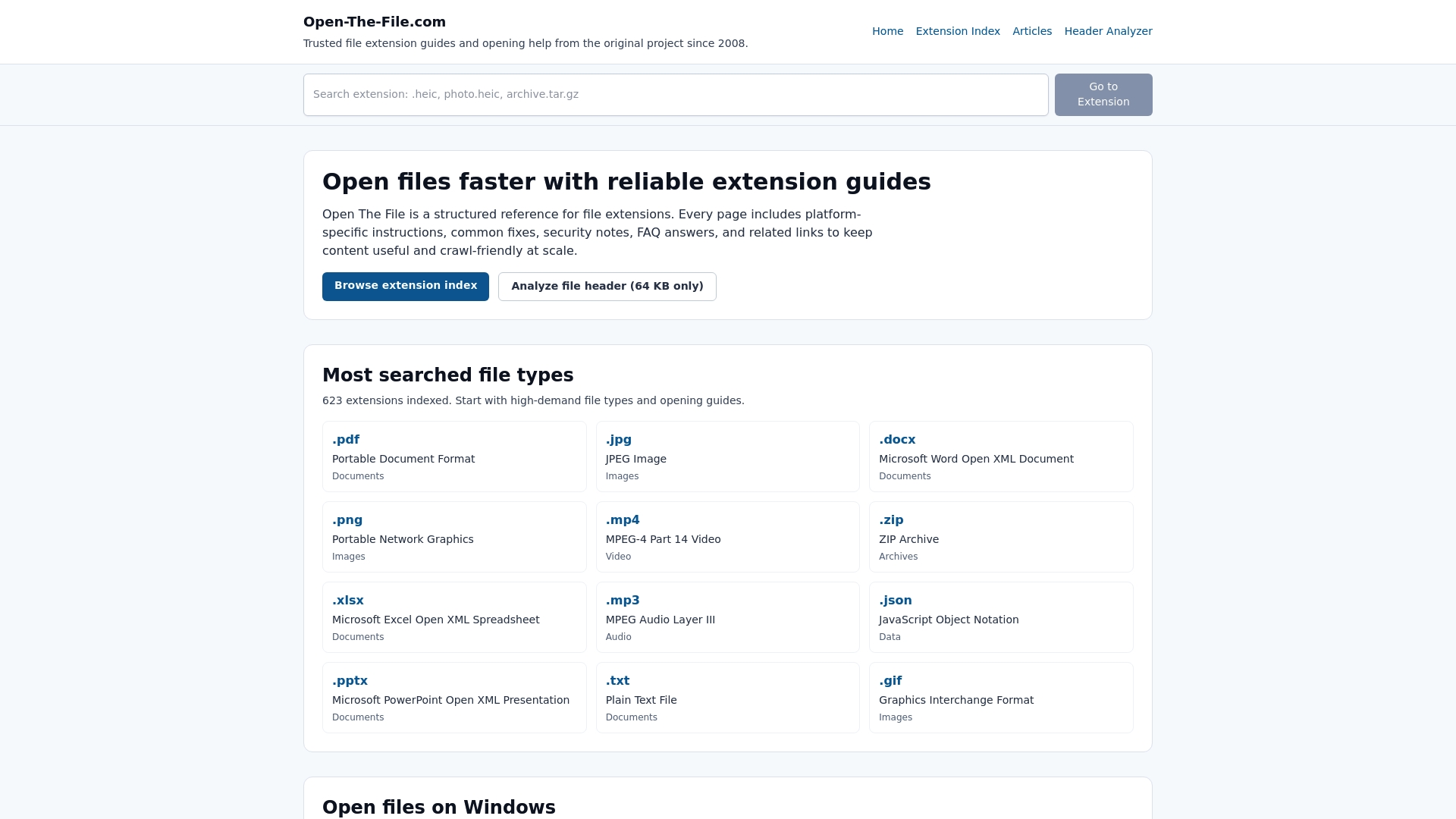
Whether you’re struggling with an unsupported format, need conversion guidance, or want to understand obscure file types, the file extension index serves as your comprehensive reference. The site’s structured approach helps casual users, content creators, and IT professionals quickly find solutions tailored to their specific operating systems and software environments. From common image formats to specialized technical files, you’ll find practical guidance backed by years of troubleshooting experience. Explore the extension guides for file types to resolve your next file challenge efficiently.
Frequently asked questions
What is the difference between JPEG and PNG?
JPEG uses lossy compression ideal for photographs, creating smaller files by discarding imperceptible details. PNG employs lossless compression perfect for graphics, preserving every pixel while supporting transparency. JPEG image files excel at photos for web and email, while PNG image files handle logos and sharp graphics better despite larger sizes.
How can I convert HEIC files to a more common format?
Use online converters, built-in OS tools, or image editing software to transform HEIC into JPEG or PNG. Windows users can install Microsoft's HEIF Image Extensions for basic support; some HEIC files may also require HEVC support. Many photo management apps and file conversion utilities handle HEIC image files seamlessly, letting you batch convert entire photo libraries quickly.
Why do some images lose quality after saving repeatedly?
Lossy formats like JPEG image files discard data each time you save, causing cumulative quality degradation. Each save cycle recompresses the already-compressed image, progressively destroying fine details. Save originals in lossless formats or create new copies instead of overwriting files to preserve quality.
When should I use GIF instead of PNG for static images?
Rarely. PNG delivers superior quality for static graphics with better transparency handling and no color limitations. Use GIF only when you need animation support or when working with legacy systems requiring the format specifically. Modern web development favors PNG for static graphics due to better compression and quality.
Can I use HEIC files on Windows computers?
Yes, but you’ll need additional software. Windows 10 and 11 can support HEIC after installing the HEIF Image Extensions from the Microsoft Store; some files may also require HEVC support. Alternatively, convert HEIC files to JPEG or PNG using online tools or dedicated conversion software before transferring to Windows devices.